Perception---you have that power.

There is purpose in design. There is information in a setting. There is truth in your environment. Fake or real, it's there.

All images are copyrighted by Heidi Hoffer unless otherwise indicated. Your courtesy in using my photographs must include crediting me as the photographer. You must tell me when and where you've used them and send the link to me showing your use of them.
Showing posts with label theatre. Show all posts

Sunday, September 27, 2015

Process and Trust for Design

 I'd like to consider how a 2D drafted thing becomes a reality.

Typically we've got a sketch, drafting, sometimes an exquisite model piece, a 3D drafting sometimes, and the final version before paint, the painter's elevation, and then the full final version. There's a lot of trust going on in the creation of this art! It take scores of people to bring to fruition.

Saturday, July 9, 2011

"Sexcetera" with NYU, Sibikwa Arts Center and Wits Drama Department

Sexcetera – an exploration of space between audience and performer, the right to choose, obsession, fetish, voyeurism, and sequence.
I used Google Sketchup 8 to create this map of the locations for our site specific performances.

Sexcetera was devised by Phyllis Klotz of the Sibikwa Arts Centre, and designed by Heidi Hoffer who is a Fulbright Scholar currently in residence at University of Pretoria Drama. The cast was made up of students from the New York University in collaboration with The University of the Witwatersrand School of the Arts Drama Department, actors from the Sibikwa Arts Centre and students from the Wits Drama Department.  It was a site specific piece, with the location being a premium space for musicians and artists as well as the production.
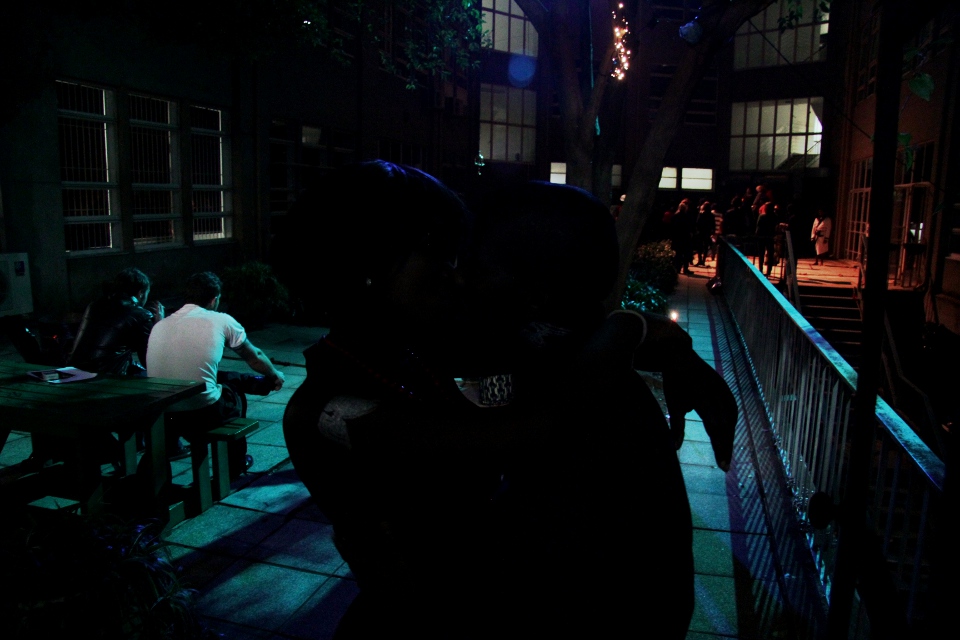
The courtyard of the Wits School of the Arts was our location. This is a view from the middle looking down the stairs towards the foot fetish corner in red light.

This view is from the Lovers doorway looking down towards the Enchained piece with performers in white across from the sultry Priced Right performance.
Lovers was performed by Thapelo Kotolo and Thandi Dube. Audience members had to squeeze their way past these two occupied performers to get into the courtyard.
Smoochers in the pathway.
Tree of Love was written and performed by the musicians Eric Namaky, Siyabulela Sifatyi and Esther Maumela.
The musicians performed love songs...what else?
And to greet you and ignore you was an angel wearing a hard hat, because love is a dangerous business. The Angel was performed by Rasta Mokhere.
An Angel to guide us through and keep an eye on things.
When you crossed the metal bridge past the Lovers if you looked down to your left you could get a top view of the dominatrici in their subterranean lair. Succumb was developed and performed by NYU students.

View from above of the Dominatrix duo.
On the left performing while standing in sinks of water was Chris Couperthwaite and Bulelwa Ndaba in Love Lost written by Jessica Annunziata. Audience members viewed them through open windows.
Love Lost written by Jessica Annunziata could be performed backwards and forwards.

Continuing to the opposite end of the courtyard from the entrance, one got a glimpse of young love/lust on a car seat. Don't worry, they didn't really do it. They just expertly gave animated explanations of the sexual feelings and thought that accompanied their date. Oops and Umms was written by Bulelwa Ndaba in collaboration with Denise Mosiana. It was performed by Denise Mosiana and Taemane Mothobi.
Performers in Oops and Umms talk about the awkwardness of love on a car seat.
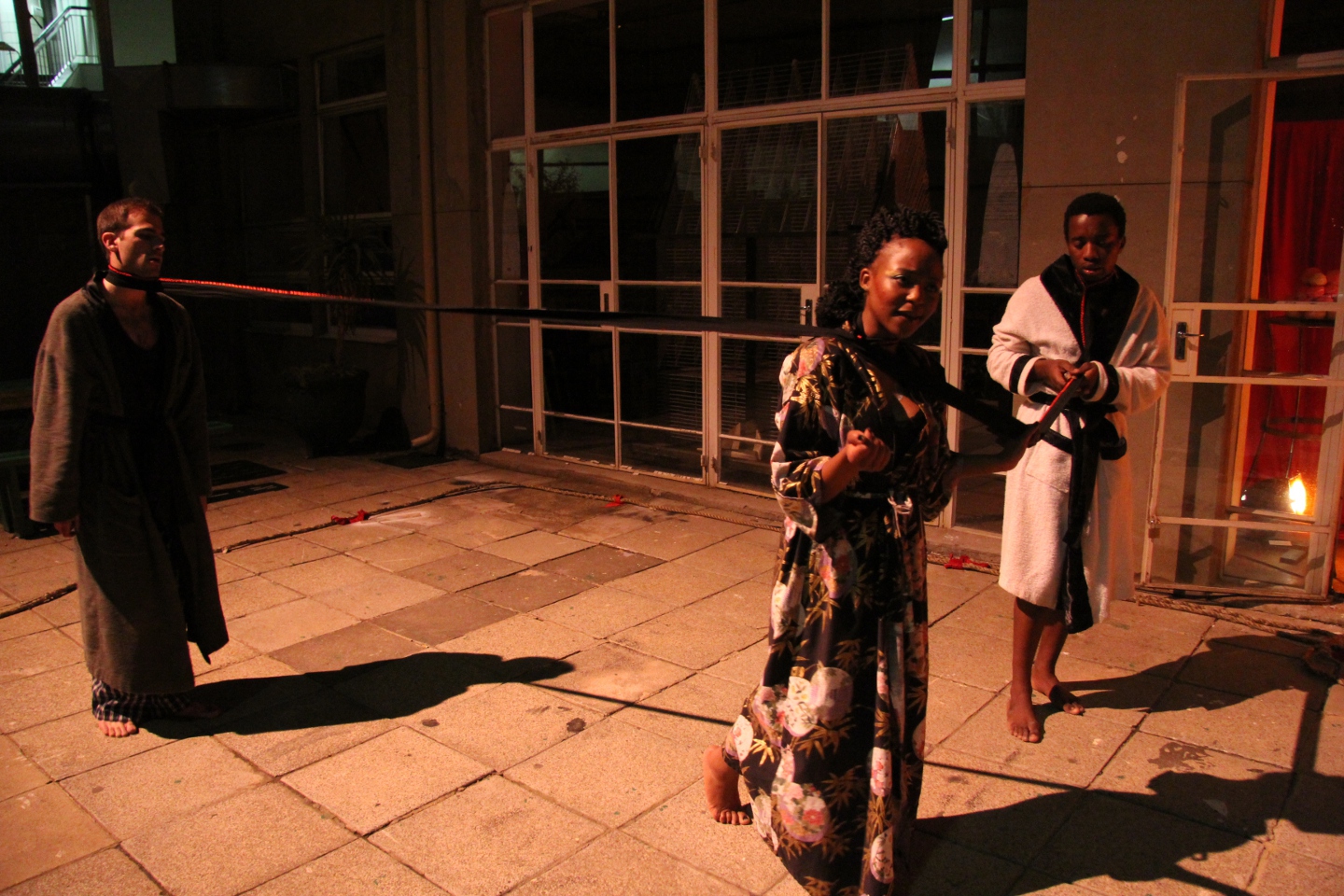
My Pastor, My Father, My Pilgrim was developed by Ethan Fishbane, Vuyelwa Maluleke, and Masiza Mbali. This performance was achingly surreal in its depiction of religious bindings.
The performers of My Pastor, My Father, My Pilgrim used long lengths of elastic to stretch and snap their ideas.
A site specific performance about sensuality, sex and acceptance is not without its body image artist. Caged was choreographed and performed by Louisa Levy.
The workshop built a "cage" for the actor in Caged to athletically manouver within while checking her reflection in shards of dangling mirrors.

The viewing of Caged brought the audience to the top of the stairs. Just underneath the stairs, lurking like a sensuous troll in a sequinned outfit was the performance of Basadi which was choreographed and performed by Freddie Nkantolo Zwane.
 Freddie Nkantolo Zwane performed near- contortionist moves in his dance of obsession with the curvy lounge chair.
Priced Right was developed and performed by Ashalin Singh and Chanelle Sardinha. This performance was reminiscent of the window displays of prostitutes in Amsterdam. Audience members got a glimpse of the power of money through the safety of a window.
Priced Right performers Ashalin Singh and Chanelle Sardinha exhibit some of what can be done for money.
Opposite the performance above was a unique poetic performance demonstrating need of acceptance and friendship and comany, and how those very things are often harmful.
Enchained was developed and performed by Raezeen Wentworth and Keith Leroyal Smith.
These performers performed circus style nearly - arial manouvers which were not completely arial because these performers were chained to the railing above.
Continuing in this basement level of the courtyard, the audience came acroos a scene of foot fetish. Foot Fetish was performed by Lesego Ngwato and Lucky Tshimbudzi.
What footsore Nurse wouldn't like to have a nice foot rub?

Lipstick was performed by Thokozane Nsibande. This actor sat on a swing, putting on his lipstick while audience membders went past him to the Foot Fetish performance or the Succumb dominatrix scene.

The tallest actor was given the task of using a bit of lipstick and a hand mirror on a swing suspended from the bridge above. He borrowed a swanky ginger coloured wig, some ladie's clothes, and voila! - a masterpiece of cross-dressing innocence.

The final destination on this level was the Succumb performance by NYU Students.
The desire for a normal life was juxtaposed with the desire for a dominatrix life in this performance of Succumb.
To quote the student Assistant Director Chris Couperthwaite in collaboration with the cast,
“The process for Sexcetera was highly personal and very organic. Grappling with the topic of sex is not easy for many people but we broke down the walls that we had built about sex, discovering as much about ourselves as we did this topic. With the direction of Phyllis Klotz we were exposed to a world of fantasy, sensuality and sexuality, working with sexologists, a dominatrix and, some of the cast observing professional strippers. We unanimously agreed upon not merely delivery of the expected but rather a highly thought provoking “sexhibition”, a show that is a creative collaboration of different voices, backgrounds, cultures and beliefs. We have grown together as a cast, exploring paths that we would not have had an opportunity to explore in any other way. It has been an unforgettable process of learning and engaging that will have lasting effects.”
Assistant Designer for the production was Chiara Moliaro. Stage Manager was Busizwe Mtshali. Assistant Stage Manager was Kgomotso Lwazi Mthembu. Crew members were Luke Webster, Darylene Pillay, Tyrel Van der Merwe, Chulekazi Mahlangeni, Karabo Sekgale, Crystal Vittee, Nicolette Spykerman, and Themba Twala.

Sunday, April 17, 2011

Dead Computer

Hello World by Design blog readers,

     Did you know computers are very expensive here in South Africa? I had the opportunity to find out when my tried and true Sony Vaio laptop expired. Shame. To sum it up, I spent hundreds of Rand trying to revive it, and it is a total loss. This accounts for the hiatus in my blogging. I am shopping for a replacement computer.

I just loved the electrical engineer's collection of computer parts and work tables in the offices where I tried to have my computer revived. The fellow in the picture managed to save the information from my hard drive.
     I have been extremely busy with teaching two design classes at the University of Pretoria and traveling to Cape Town to interview stage managers, production managers and directors from the Artscape Theatre to the Spier Winery amphitheatre. Photos and reports should come soon. But in the meantime I am also designing a show at the University of the Witwatersrand, assisting on the lighting ( and doing some scene painting, too) for Winnie the Opera--at the Pretoria State Theatre, doing a scenic art workshop at the Market Theatre centered around sculptural destruction and ageing...and designing two shows for University of Pretoria.

     The 1,155 seat open-air Spier Amphitheatre in Stellenbosch near Cape Town was the site of a fine evening of Afrikaans Cabaret. The performance was In Villiers de Villiers and Amanda Strydom with Music Director Janine Neethling. This outdoor venue has become a sought-after venue for productions ranging from opera to drama since its inception some years ago. It is also the primary venue for Spier's annual Summer Festival, which runs from November to March. This musical evening was part of the Woordfees Festival week. I specifically interviewed Spier Amphitheatre's world-class Stage Manager Ronel Jordaan whose stage management skills have taken her on Broadway shows through most of Asia and the UK as well as South Africa. 

    Wednesday, March 16th I took nearly 30 UP students,UPArts staff and faculty to the Cirque Du Soleil's venue in Johannesburg for a much sought after backstage tour.  A full report will follow in another blogpost but here's a teaser.


Backstage Tour of Cirque du Soleil's Saltimbanco in Johannesburg at the Coca-Cola Dome.

     Saturday, March 26th I provided a huge all-day lighting workshop at University of Pretoria courtesy of Johnny Heinemann and his UPArts colleagues and Ian Blair of Prosound, the company that provided all of the ETC lighting equipment and EOS and ION lighting boards. We had nearly 50 participants including professional designers, faculty and students.We also had two professional Tango dancers who brought the rhythms of the dance into our bodies so we could design and light two Tangoes in the afternoon.


Prosound (http://www.prosound.co.za/) provided ETC lighting equipment for a huge lighting workshop at the University of Pretoria March 26. Heidi Hoffer directed the participants through many hands-on lighting applications including accessories, lens sizes and lighting two competitive Tangoes.


Thursday, December 9, 2010

University of Johannesburg's Fantastic Theatre Part 1

The 436 seat proscenium theatre at the University of Johannesburg's Kingsway Campus theatre also features a recent lighting console upgrade to a GrandMA Ultra-Light. More and more theatres and lighting designers in South Africa are specifying this GrandMA console for their venues.
     South African Theatre constulant, Scenic and Lighting Designer Denis Hutchinson made it possible for me to tour the University of Johannesburg Theatre with his architects and clients for a future project of his. We were looking at architectural elements specific to a venue complex the new project might use.
     As I am involved in my own discussions with architects for the new performing arts center at Oklahoma State University, I found this hands-on examination very successful and very useful.
          The UJ Theatre boasts a full balcony rail for a low FOH position, and two higher FOH positions as well. There is a full height platform at the last position with a removable railing specifically designed to accomodate  the long snout of two followspots.

In this photo you can see one of the followspots pointed down at the stage. The lighting pipe has been removed so as to not interfere with the arc of the followspot nor the light beam. It is a clear straight shot to the stage. The flat balcony floor on which its rests has good head clearance, and room for technicians to safely move around one another.
     The two FOH positions are very electrician - friendly. ( I pretended to adjust the focus and shutters on one conventional to see how easy that would be from the catwalk position) The instruments are on pipes right at your feet or your waist, and there is another lighting pipe available right at your head height.
     The UJ Theatre also has a pipe over the apron for sound equipment, and another pipe over the apron for lighting equipment. Both of these are on winches. The remainder of the fly system is a traditional single-purchase fly system.

Here's the tour group full of clients, architects, consultant and the UJ technician.
  More information about this theatre will be in an upcoming blogpost.


Saturday, October 23, 2010

Stage Lighting Instruments Used in The Wits Theatres

          Most of the theatre lighting technology at Wits is from Europe, with a small number of ETC Source Four Zooms from the United States. The lighting consoles include a Strand series 200 (manual, 24 Channel, 2-Preset) and a Strand series 300 (programmable). The software for these has been discontinued, so as they fail they must be replaced.
Julian, the head of lighting here has been trying out an ETC ION and a Grand MA. ETC unfortunately as yet does not have the support back-up necessary to really land a sale, yet, but I know the groundwork is being made with certain vendors here. The Grand MA Ultra, seems to be the current choice of replacement console for the main theatre. Most everyone here relies upon Strand equipment.

          (The theatre on the education campus has a Strand MX with 48 channels. This theatre, called the “Space Frame” is certainly an interesting reconfigurable theatre which I will address in another blogpost.)

Theatre Lighting at Wits…

To begin, while the stage pin connector is a standard 2P&G, it is rated for 16 amps at 250 volts, and looks triangular.

There is a great safety item in all modern household circuits here as well as on all of the circuits you’d plug stage instruments into: each circuit has its own switch!
Circuit # 102 has its own 2 pin and ground outlet, complete with rocker switch to turn the circuit on or off. It also has a masking tape label for what gets circuited when the plot is restored to the standard plot.
In the above picture you can see the end of one of the stage electrics, with its top batten, electrical raceway, and bottom hanging batten. If the instrument doesn’t work after you’ve hung and circuited it for show, part of the trouble-shooting includes seeing if the damned switch was turned on!! ALL circuits have this safety item whether they are standard wall outlets or stage circuits.
This is a Harmony Profile 22/40 Zoom 
One of the well-used instruments here is the Harmony 22/40 degree beam angle zoom and it’s narrower brother, the Harmony 15/22 degree beam angle zoom. These were manufactured by Strand in 1981, and have been  steadfast performers. They are an ellipsoidal spotlight, shutterable, accept gobos, and work very well at hard focus or soft focus. Here is a link to the historic Rank Strand instrument archive featuring these babies: http://www.strandarchive.co.uk/lanterns/documents/harmony2240data1.jpg

This is a Harmony PC instrument.
The Harmony PC is the most interesting instrument because it is not shutterable and it’s beam quality lies somewhere between that of an ellipsoidal and a Fresnel. It has a single adjustment (knob is featured in the picture below) for a diffused beam variable from a very tight spot, similar to a beamlight, to a wide angle flood. The beam edge quality, which is free from colouration, is similar to a soft-focused ellipsoidal spot, but much tighter than that of a Fresnel.

The underside of a Harmony PC.
In the above picture showing the bottom of the Harmony PC you can see the round black knob that you loosen to slide the lamp/reflector sled assembly forwards or backwards in the slot. This particular instrument has the lamp/reflector close to the lens for a wide beam. (Instrument is pointing downwards to the stage floor)  Here is the link to the historic document from the Strand Archives about the Harmony PC: http://www.strandarchive.co.uk/lanterns/documents/harmonypcdata1.jpg

Checking the circuit to a Quattro Pro.
In this photo above, the student lighting technician is turning on the circuit to a Strand Quattro PM Fixed Angle profile (650w)... and apparently held together by black gaffer tape, as identified by Julian. Behind her head is one of the Harmony Fresnels. Here's the link to the Harmony Fresnel: http://www.strandarchive.co.uk/lanterns/documents/harmonyfdata1.jpg


The beautiful tin ceiling of this theatre has been painted black, of course. This picture was taken in The Nunnery Theatre at Wits during the lighting design class final exam.

More lighting instrument stories are planned...including dimmable fluorescents and Fresnels that look like metal eggs!

Sunday, September 26, 2010

A Few Performance Art Installations

Signatures was curated by Wits scenographer Jenni-Lee Crewe. Her students were the artists, and each had to create a piece involving their take on what performance art is today. I provided most of the lighting - there was one piece that defied lighting as it's performance was all smell and tactile work. One piece used large maps of differing translucencies and a ceiling of ever-changing map projections and post-it-notes to locate memories. My photos of that unfortunately did not come out. Three of the pieces were on the amphitheatre stage which shared the same setting, including a rectangle of glossy black on the floor. In one case it was a duck pond, and in another it was a barrier for the performance.
This piece involves heavy metal safes, white gloves, ear phones, and things inside the safes that you could look at and consider. The safes were presented on white pedestals with white fabric leading down to them from the ceiling.

There were seven of these safes, all presented as if they were in a gallery. Very audience-friendly.

Across the room from the safes was this cut-out tree with all the good and bad terms for "woman" painted on it. A woman in yellow sat underneath with a huge pile of lemons, eating lemons like they were going out of style.

At the end of the room was a room-sized box of paper with a doorway and a window and a moveable lighting instrument. Participants could draw or paint the outlines of their shadows. In some cases, outlines were enhanced with paint after being drawn in pencil. This could be viewed from above, through the door or window, and through the walls from outside since the walls were just thin paper.

Here is the artist outlining a particpant's shadow onto one of the walls as seen from the outside of the box.

One of the performances in the Amphitheatre used masks, and sound effects came from the actors. The glossy black rectangle was a fishing pond with ducks in it for this one.
One of the Amphitheatre performances used only the glossy back rectangle, with dance-like movements contained tightly by the rectangle. Notice, too, the rectangular mirrors in the upper right reflecting the activity.
In this third Amphitheatre performance art piece, the actor's movements were directed over a loudspeaker by someone in the lighting booth, who changed the procedure every performance.
In the final installation, the audience was invited to go outdoors to watch and hear the boys in blue commune with a blue-wrapped tree against the sodium vapour lights of the city.

I should add that if and when I can get other people's photos of the smells and the maps installations, I would love to post them here as well. I would also love to get a close-up of the masks used in the duck-pond performance. They were papier-mache masks, very lightweight.

Saturday, September 11, 2010

Wits Theatre Facility Tour Part 2

So far, I’ve shown you pictures of main theatre lobby and loading bay. Now, we’re off to the scene shop, costume shop and more! More parts of the tour will follow. If you're interested in a specific area, let me know and I will seek permission to photograph it to show you how things are done here. It is really interesting that the flow of the architecture for the purpose of making theatre is similar to everywhere else I've been. I mean, a light booth is a light booth is a light booth. The basic functions remain the same yet the chain of command can be different.
The workshop is full of natural light, and is quite large. The TD and the ME’s offices are in one corner of the shop, with the PM’s office right above theirs.

The paint area functions as a catch-all for the several shows that are produced by the workshop. Once a show buys paint, it is difficult to keep that paint in stock because every last drop is used on another show and so on with very little waste.

The workshop has your typical arc welder, oxyacetylene rig, and band-saw and other power tools.
Here is the arc welder.

And here is flat storage.
Here is the Greenroom for the Wits Main Theatre.

The dressingrooms are light and airy and have lockers for street-clothes.

Upstairs in the hallway off the costume workshop, there are windows into the scene shop which allow natural light into the hallway, and a great view to the construction areas below.

Here’s another picture of the hallway showing how big the windows are that overlook the workshop.
The costume shop is a bright and cheerful place to work. It is small like many other costume shops I’ve been in, and this one has the added duty of supervising the small properties such as liquor bottles and telephones.

Storage for notions and jewelry-making etc. are near the offices of the Costumer/Shop Manager and her staff.

This is a view of the costume shop looking toward the offices. Notice the Juki!!

The laundry room.

The shoe room.

The small props room.

One row of the costume storage room.

Some of the colorful costumes in storage.

The students, staff and patrons get to grab a drink or a snack from the cafĂ©  in the lobby, and come outside onto a terrace for some sunshine.

One of the other venues managed by the Wits Theatre complex is The Nunnery, actually part of an old Catholic church.

The Drama Department is in a different building from the Wits Main Theatre. It is across the road in what used to be a dental school. This is the lobby of the Wits School of the Arts in which you'll find the Drama Department. The school houses all of the arts, and actually several buildings are used to contain rehearsal rooms, offices, studios, workshops, practice rooms, sound labs, and so on.