Perception---you have that power.

There is purpose in design. There is information in a setting. There is truth in your environment. Fake or real, it's there.

All images are copyrighted by Heidi Hoffer unless otherwise indicated. Your courtesy in using my photographs must include crediting me as the photographer. You must tell me when and where you've used them and send the link to me showing your use of them.
Showing posts with label Lighting. Show all posts

Thursday, January 5, 2012

Soweto Theatre Jabulani Update

Thanks to Denis Hutchinson, Theatre Consultant on the project, I have three new photos of the theatre complex to share!

The land in front of the complex will get a beautiful paving design.
See all those dangling wires? It looks like the proscenium theatre is getting its fly system in order.
This theatre looks like it has its sound absorption materials in place.

Sunday, April 17, 2011

Dead Computer

Hello World by Design blog readers,

     Did you know computers are very expensive here in South Africa? I had the opportunity to find out when my tried and true Sony Vaio laptop expired. Shame. To sum it up, I spent hundreds of Rand trying to revive it, and it is a total loss. This accounts for the hiatus in my blogging. I am shopping for a replacement computer.

I just loved the electrical engineer's collection of computer parts and work tables in the offices where I tried to have my computer revived. The fellow in the picture managed to save the information from my hard drive.
     I have been extremely busy with teaching two design classes at the University of Pretoria and traveling to Cape Town to interview stage managers, production managers and directors from the Artscape Theatre to the Spier Winery amphitheatre. Photos and reports should come soon. But in the meantime I am also designing a show at the University of the Witwatersrand, assisting on the lighting ( and doing some scene painting, too) for Winnie the Opera--at the Pretoria State Theatre, doing a scenic art workshop at the Market Theatre centered around sculptural destruction and ageing...and designing two shows for University of Pretoria.

     The 1,155 seat open-air Spier Amphitheatre in Stellenbosch near Cape Town was the site of a fine evening of Afrikaans Cabaret. The performance was In Villiers de Villiers and Amanda Strydom with Music Director Janine Neethling. This outdoor venue has become a sought-after venue for productions ranging from opera to drama since its inception some years ago. It is also the primary venue for Spier's annual Summer Festival, which runs from November to March. This musical evening was part of the Woordfees Festival week. I specifically interviewed Spier Amphitheatre's world-class Stage Manager Ronel Jordaan whose stage management skills have taken her on Broadway shows through most of Asia and the UK as well as South Africa. 

    Wednesday, March 16th I took nearly 30 UP students,UPArts staff and faculty to the Cirque Du Soleil's venue in Johannesburg for a much sought after backstage tour.  A full report will follow in another blogpost but here's a teaser.
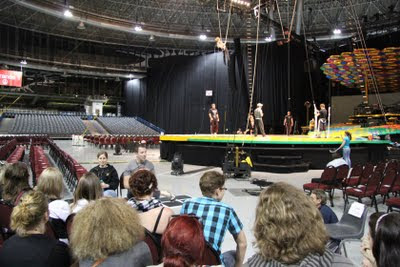

Backstage Tour of Cirque du Soleil's Saltimbanco in Johannesburg at the Coca-Cola Dome.

     Saturday, March 26th I provided a huge all-day lighting workshop at University of Pretoria courtesy of Johnny Heinemann and his UPArts colleagues and Ian Blair of Prosound, the company that provided all of the ETC lighting equipment and EOS and ION lighting boards. We had nearly 50 participants including professional designers, faculty and students.We also had two professional Tango dancers who brought the rhythms of the dance into our bodies so we could design and light two Tangoes in the afternoon.


Prosound (http://www.prosound.co.za/) provided ETC lighting equipment for a huge lighting workshop at the University of Pretoria March 26. Heidi Hoffer directed the participants through many hands-on lighting applications including accessories, lens sizes and lighting two competitive Tangoes.


Sunday, December 12, 2010

University of Johannesburg's Fantastic Theatre Part 4

Stage Lighting Positions and Work Areas
Theatre technicians get to work in the most interesting nooks and crannies of theatres. This theatre is no exception, however, the physical space requried for a technician to perform his or her work has been considered, and working in this theatre would be a pleasure.
The lighting trees have rear wheels with a cantilevered  post for weights and coiled cables.
Lighting ladders are widely used for high sidelighting positions. A close up view of this image will show you that safety cables are being used to insure the security of the instruments on the ladder.
The lighting pipes have been flown in for a close trim to the set. The setting is for the TV show PROESSTRAAT.
In this image you can see the three basic Front of House (FOH) lighting positions. The curved balcony lighting pipe is somewhat difficult to reach due to the glass railing. Not recommended.
This is a view from the corner of the last FOH position. Notice the ceiling just above the instruments and the acoustical squares across the way on the opposite wall of the theatre.

This apron cove lighting position is reached from the ladder up to the fly gallery. There is a small platform for the technician to stand on while working on the lighting instruments.

Continuing up the ladder to the fly gallery you come to the first level above the stage. Across the way you can see the dimmers and above the dimmers on the left you can see the slatted exhaust panel. Above that you can see the ceiling of the grid with its underhung sheaves.

Here is a close-up of the sheaves taken from the 3rd level or loading platform. The sheaves have easy and safe catwalk access for maintenance and repair.
In the trap room we found the lighting and sound desks. Normally these controls would be located in the booth, but for the TV show, the director wanted control from under the stage. The trap room includes underneath the orchestra pit. There's enough height down here to include a future lift system for the apron.

The University of Johannesburg runs it's theatre lighting system from a GrandMA lighting console.


Sunday, October 31, 2010

More Lighting Instruments Found at Wits

An old floodlight found at the Wits Theatre
Every theatre needs to have an instrument that looks so old it is older than Yoda, right? Here's a floodlight that fits the description.
And here is the view from the front:
Looking at the front end of the floodlight showing the pebbled aluminum reflector.
And, to contrast that old instrument with modernity, here are two favourites: the Source Four Zoom and the Martin 300.
The Source Four Zoom continues the trend of South African lighting designers prefering zoom instruments over fixed angle instruments.  

The Martin 300
  And at the cyc are these quad cyclights:
A Quad Cyclight.
And the sidelighting work horse of this theatre is the Par Can, pictured below.
Par Can
Promoting the snazzy city feeling in the lobbies, the directional signs are done in neon lights.
Directional signs in the Wits Theatre complex are done in neon lighting. It makes the theatre look trendy!

Saturday, October 23, 2010

Stage Lighting Instruments Used in The Wits Theatres

          Most of the theatre lighting technology at Wits is from Europe, with a small number of ETC Source Four Zooms from the United States. The lighting consoles include a Strand series 200 (manual, 24 Channel, 2-Preset) and a Strand series 300 (programmable). The software for these has been discontinued, so as they fail they must be replaced.
Julian, the head of lighting here has been trying out an ETC ION and a Grand MA. ETC unfortunately as yet does not have the support back-up necessary to really land a sale, yet, but I know the groundwork is being made with certain vendors here. The Grand MA Ultra, seems to be the current choice of replacement console for the main theatre. Most everyone here relies upon Strand equipment.

          (The theatre on the education campus has a Strand MX with 48 channels. This theatre, called the “Space Frame” is certainly an interesting reconfigurable theatre which I will address in another blogpost.)

Theatre Lighting at Wits…

To begin, while the stage pin connector is a standard 2P&G, it is rated for 16 amps at 250 volts, and looks triangular.

There is a great safety item in all modern household circuits here as well as on all of the circuits you’d plug stage instruments into: each circuit has its own switch!
Circuit # 102 has its own 2 pin and ground outlet, complete with rocker switch to turn the circuit on or off. It also has a masking tape label for what gets circuited when the plot is restored to the standard plot.
In the above picture you can see the end of one of the stage electrics, with its top batten, electrical raceway, and bottom hanging batten. If the instrument doesn’t work after you’ve hung and circuited it for show, part of the trouble-shooting includes seeing if the damned switch was turned on!! ALL circuits have this safety item whether they are standard wall outlets or stage circuits.
This is a Harmony Profile 22/40 Zoom 
One of the well-used instruments here is the Harmony 22/40 degree beam angle zoom and it’s narrower brother, the Harmony 15/22 degree beam angle zoom. These were manufactured by Strand in 1981, and have been  steadfast performers. They are an ellipsoidal spotlight, shutterable, accept gobos, and work very well at hard focus or soft focus. Here is a link to the historic Rank Strand instrument archive featuring these babies: http://www.strandarchive.co.uk/lanterns/documents/harmony2240data1.jpg

This is a Harmony PC instrument.
The Harmony PC is the most interesting instrument because it is not shutterable and it’s beam quality lies somewhere between that of an ellipsoidal and a Fresnel. It has a single adjustment (knob is featured in the picture below) for a diffused beam variable from a very tight spot, similar to a beamlight, to a wide angle flood. The beam edge quality, which is free from colouration, is similar to a soft-focused ellipsoidal spot, but much tighter than that of a Fresnel.

The underside of a Harmony PC.
In the above picture showing the bottom of the Harmony PC you can see the round black knob that you loosen to slide the lamp/reflector sled assembly forwards or backwards in the slot. This particular instrument has the lamp/reflector close to the lens for a wide beam. (Instrument is pointing downwards to the stage floor)  Here is the link to the historic document from the Strand Archives about the Harmony PC: http://www.strandarchive.co.uk/lanterns/documents/harmonypcdata1.jpg

Checking the circuit to a Quattro Pro.
In this photo above, the student lighting technician is turning on the circuit to a Strand Quattro PM Fixed Angle profile (650w)... and apparently held together by black gaffer tape, as identified by Julian. Behind her head is one of the Harmony Fresnels. Here's the link to the Harmony Fresnel: http://www.strandarchive.co.uk/lanterns/documents/harmonyfdata1.jpg


The beautiful tin ceiling of this theatre has been painted black, of course. This picture was taken in The Nunnery Theatre at Wits during the lighting design class final exam.

More lighting instrument stories are planned...including dimmable fluorescents and Fresnels that look like metal eggs!